
Language is a fundamental aspect of the human experience, serving as a cornerstone for communication, expression, and the transmission of knowledge. Since time immemorial the societies/countries across the world which are more literate on average flourished better than those where there is severe restriction to study and gain knowledge.
Being literate and being able to study a particular language afforded many groups an assymmetric power over those who didn’t have access to the ideas and knowledge contained within the language. Many groups around the globe have weilded this power over people by restricting their access to language.
One of the most widespread and systematic examples was the prohibition of enslaved Africans from being taught to read and write in the slavery era of the United States and other parts of the Americas.
During the British colonial rule in India, knowledge of English became a gatekeeping mechanism, with the colonizers ensuring English education was limited primarily to elite Indian populations. This restricted information and administrative power held by the British from permeating to the wider Indian masses.
In Nazi Germany, there were bans on using the Hebrew language and other efforts to suppress and eradicate Jewish literacy, language and culture as part of the anti-Semitic policies.
Language was not just used as a power tool in diverse political climates but it is also heavily used by many prominent religions as a way to keep their adherents in order.The monopolization of Sanskrit language and knowledge by the upper castes (particularly the Brahmins) in ancient India contributed significantly to reinforcing caste-based discrimination and subjugation of the lower castes. Education and training in Sanskrit was largely the exclusive domain of the upper caste Brahmins and to a lesser extent the Kshatriya nobility. This linguistic exclusion from Sanskrit acted as a powerful gatekeeper, denying the lower castes access to education, wisdom, upward socio-economic mobility and empowerment.
Similar stories can be found in the Arab world with Islam and access to Classical Arabic and in Roman world with Christianity and access to Latin. In medieval Christian world the scholarship in Bibilical texts was available only to priviliged few who are trained in Ecclesiastical Latin.When Martin Luther and other Protestant reformers translated the Bible into vernacular European languages like German, they were essentially democratizing access to the sacred scriptural knowledge that had been artificially limited to the Latin-educated clergy and monastics. These instances demonstrate how controlling a “divine language” (be it Sanskrit, Latin or Classical Arabic) was a pivotal technique in subjugation of massess.
The story is not over yet. So far, we looked at external power structures which either actively or passively restricted people’s access to language. Let’s now look at instances where in people self-imposed access to certain new age languages and consider the people proficient in these languages as “superior” by placing them on a pedestal.
Enter ‘Math’ and ‘Programming’.
Math was introduced to each one of us from very early on. From counting numbers on hands to doing basic arithmetic everyone is proficient in some basic math but people’s perception of math might have taken a turn when they are introduced to algebra and a different way of notating things. It probably might have gotten further complicated with even more additional symbols of Greek alphabet.
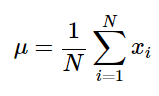
To the uninitiated, the above formula looks stupefying but in actuality it is a simple formula to calculate average value of group of numbers . Let’s look at the same idea expressed in a programming language.

Terrifying?!! (Side note – I am just as ignorant in programming as an ordinary person and I used internet search to write me this, although, I learned to program more than a decade ago and pretty much forgot all of it).
Just like how languages like Sanskrit or Latin were mystified and their access restricted to certain elite groups, thereby denying the masses entry into those knowledge domains, although involuntary, the symbols and notation of mathematics and programming can likewise create a similar sense of it being an esoteric, inaccessible field of knowledge.
Fundamentally, we must recognize that language is a tool of human expression and meaning-making – it is not inherently sacred or esoteric, but rather a malleable medium that can be democratized. Translating works of Ancient Languages into vernacular languages will help people broaden their knowledge base. Similarly, teaching mathematics and programming languages using intuitive, everyday examples rather than privileging formal notation systems will empower people to engage with them organically.
Ultimately, by dismantling the artificial barriers erected around “elite” languages, we can foster more equitable, inclusive, and empowered societies where knowledge and self-actualization are not restricted to the privileged few. The path towards a more just world requires a fundamental rethinking of how we conceptualize, teach, and disseminate the languages that shape human civilization.
 Insights into an examined life